In brief:
According to the root assumptions of science — that for each physical effect there is a physical cause — physical movement is theoretically impossible, yet we routinely move our bodies in everyday life. The root assumptions cannot explain, or be precisely correlated with physical phenomena.
In detail:
Correct solutions to Zeno's Paradoxes require that they be fully congruent with observable reality. That is, they are at least not contrary to experimental or physical evidence.
The article "Congruent Solutions to Zeno's Paradoxes" provides an overview of how the evidence of quantum mechanics can be integrated with everyday life to correctly solve the (supposedly perplexing) issue of the paradox of physical motion.
All other solutions that rely on infinite-series (typical of the vast majority of solutions offered in textbooks, universities and the Internet) require the assumption of 'perfect continuity' of space-time and physical motion, an assumption that is not supported by the evidence of quantum mechanics. in fact, if movement were continuous, our whole universe would disappear in an infinite flash of energy.1 As physicist David Bohm stated: "according to the quantum theory, movement is not fundamentally continuous."2. As renowned physicist Richard Feynman remarked over 40 years ago "...that space is continuous is, I believe, wrong."3,4
"If infinite-series do not predict physical movement in the details, they cannot be used in the details of physical movement."
[Stephen Pirie, July 2011]
In light of the many theoretical advances and experimental results of quantum physics, we can confidently expect that the vast majority of scientific and philosophical opinion on the subject of Zeno's Paradoxes (based on infinite-series solutions which are reliant on the assumption of a continuous space-time) is wrong.
As detailed in the section "Zeno's Paradoxes" various 'thought-experiments' easily and inexorably undermine the standard 'perfect-continuity' assumptions of science. The experiments reveal how standard infinite-series solutions are unable to explain or correspond to the the measurable, observable facts. The first "Proof of the Impossibility of Physical Movement" uses science's own reliance on strict determinism (namely: identifiable, verifiable physical causes for each and every physical effect) to demonstrate the utter impossibility of physical movement.
In the Third Proof of the Impossibility of Physical Movement, the de Broglie wave relation shows the inability to apply standard infinite-series solutions to the issue of movement. For example, as detailed here, the calculation of the de Broglie wavelength (λ) of a cricket ball of mass 0.15Kgs, moving at 40 metres/sec is 1.11 x 10⁻³⁴ metres. The cricket ball MUST traverse all increments in distance due to infinite-series solutions requiring physical momentum and physical positioning at each and every infinitesimal micro-movement along its path. So when the ball traverses a micro-interval of say 10-2000 metres, the de Broglie wavelength is many thousands (and ultimately, millions, billions and trillions ...and ever greater) multiples larger than those increments in travel. However, the de Broglie wavelength indicates the range of possible positions and momenta of the ball. In effect, for the ball to traverse the endless (infinite) micro-increments in travel (which according to standard infinite-series solutions, it MUST do so), then the ball is "superpositioned" well "outside" of where it precisely and exactly HAS to be (according to the algebra of infinite-series solutions) at EVERY point in time, while ever it is traveling from point A to B.
Clearly this is a nonsense situation, with the easy sensible conclusion being:
theories based on infinite-series obviously and demonstrably do not solve Zeno's Paradoxes.
A pertinent question to ask is "Given the quantum evidence, and a modicum of commonsense, why has our world-view not evolved to fit the facts? Why do we, culturally, continue to ignore evidence and the commonsense arguments that invalidate standard Newtonian solutions to Zeno's Paradoxes?"
The answer is, I believe, due to racial immaturity and short-term expediency (greed).
As explained (in the blog post, "The Travesty of Modern Science"),
Zeno’s Paradoxes together with quantum experimental evidence telegraphs that the widely-accepted standard view of our physical universe is no longer deeply congruent with the facts.
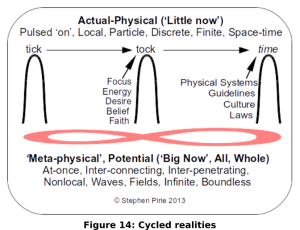
A new holodynamic systems model — one that includes the physical evidence of a discontinuous space with that of a continuous (mathematical) meta-space — is required.
Within this context (of a discontinuous space | continuous meta-space model) contemporary science provides only a limited snapshot of a far deeper multidimensional existence. As covered in more detail at this and related sites, the world we experience, one amongst limitless others, is intimately connected with, and co-created through our choices.
To say or believe otherwise requires a small-ego (selfish) persona that seeks to remain disconnected in order to avoid responsibility for the resultant reality.
While appearing expedient in the short term (e.g. enabling fast food production using antibiotics/ growth hormones / caged hens / testing medications & cosmetics on animals etc) we ultimately debase ourselves, deepening our disconnect with the natural world.
That, I sense, is the reason many will continue to avoid recognising why we cannot solve Zeno’s Paradoxes using infinite series.
Stephen Pirie
Author, Simple Tools for Clarity, Understanding and Betterment
- 1. According to physicist Richard Morris, Maxwell's equations predict "that electrons circling an atomic nucleus would radiate energy so rapidly that atoms should quickly collapse."As British physicist Paul Davies has pointed out, "the energy released under such circumstances should have been infinite."
- 2. David Bohm, Wholeness and the Implicate Order, Routledge, London 1995, page 202.
- 3. Professor Richard Feynman, The Messenger Series: Seeking New Laws.
- 4. As is explained in the section "Zeno's Paradoxes", the crux of the problem, and why the assumptions of perfect (infinite, ceaseless, unending) divisibility of our space-time persist and form the basis for the vast majority of assumed solutions, arises as a result of our cultural disconnect. That disconnect enables mathematicians to blithely disregard the true meaning of 'infinity', treating 'it' as a 'thing' that can be manipulated by various mathematical equations and expressions.It is this objectification of that which is, and will remain beyond any description, analysis or mathematical expression that is the core of the dilemma. It is this cultural (and traditionally Western) reductionism that blinds many to the art and depth of the paradoxes.
 "The Dynamics of Gender and Life" ebook is now available at